Fate

Fate
Team Size: 10
Duration: 7 weeks
Finished
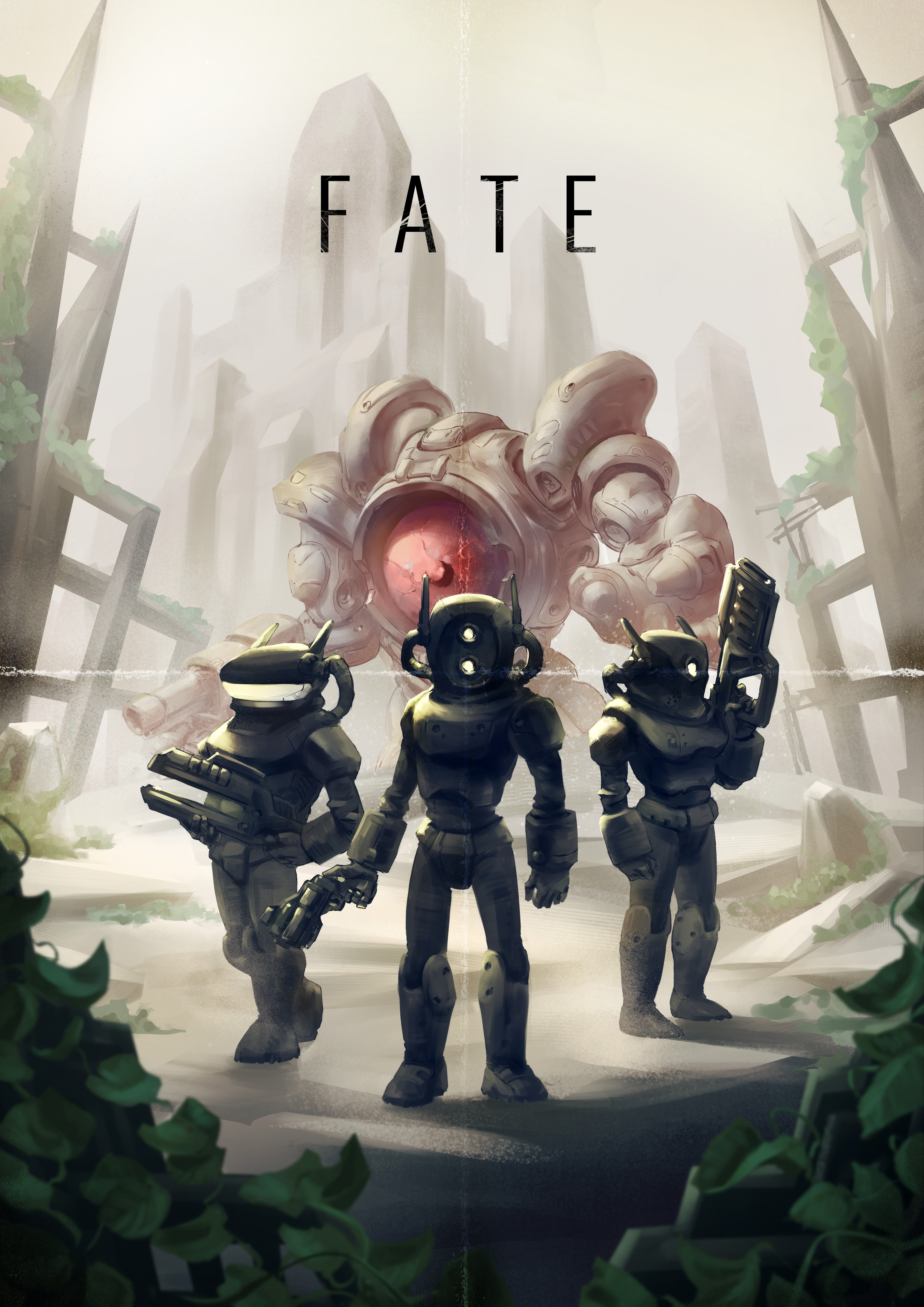
An online co-op multiplayer FPS revolving around a "Sustainability" theme, inspired by games such as Destiny, Risk of Rain and Overwatch. The game takes place in an abandoned, overgrown and semi-futuristic environment. The 'sustainability'-take manifests itself through the acquisition of powerful but double-edged buffs, set dressing, and theme-related puzzles during encounter events.
Main Responsibilities
- Enemy AI. Implemented enemy decision-making using State Trees, along with navigational differences between enemy types through NavAreas, NavFilters, SmartNavLinkProxies and varying agent specs such as radius and step height. Also handled aggro management and unreachable-target handling.
- Procedural Level Generation. Prototyped a seed-based procedural level generator that spawned rooms based on type, quantity and progression rules. The system was scrapped midway throught the project due to an unforeseen replication problem related to level instancing.
- Room Subsystem & Level Streaming. Built the server-authoritative RoomSubsystem that tracks encounter objectives, enemy spawner activations, entry/exit points and missing-player teleportation, combined with Level Streaming Volumes to keep at most three levels loaded at a time.
- Workflow & Pipeline. Established a level design workflow pipeline that allowed multiple people to work on levels simultaneously, and shifted room-management systems to be room-specific and shape-agnostic.
- Team Support. Hooked up audio cues, damage application and animations using GAS, connected the two puzzle systems to the room subsystem, guided the boss implementation's State Tree structure, assisted designers with enemy design directions and did set dressing where time management required it.
Procedural Level Generation
One of the earliest stages of the procedural level generation, featuring a hexagonal room layout. The general idea was to be able to provide an optional seed for reproducible levels, spawn specific room types based on criteria, and cap both the amount of type-specific rooms and the total amount of rooms. This first version did not take the desire for a linear map into account, something the later square-room version fixed.
- Optional seed for reproducible levels
- Room types spawned based on criteria and intervals
- Limits for type-specific rooms and total rooms
Pivot: Level Streaming Volumes
With the pivot from procedurally generated levels we decided to instead do fewer levels but with more creativity and purpose for each room. Since each level would be relatively complex given the new design-schema, we deemed it necessary to use Level Streaming. Greater emphasis was now put on the robustness of the room subsystem, as it would be the glue for keeping all systems, encounters, players and triggers available and ready while not dragging down performance too much.
- Pivot away from procedural generation
- Linear level flow with greater per-level creativity
- Greater emphasis on Room Subsystem to act as a common integration area
Enemy Prototype: Psycho
The first enemy prototype, the 'Psycho', charges towards its target, randomly dodges incoming bullets while charging and leaps at the player when close enough. The behavior might not sound overly complex, but it hides a lot of invisible work such as perception, aggro determination and out-of-bounds scenarios. With the game aiming for swarms of 50+ enemies, behavior like this quickly became overwhelming, and the prototype was scrapped in favor of simpler enemies.
- Charge, dodge and leap behavior
- Random bullet dodging limited by dash charges
- Scrapped in favor of swarm-friendly enemies
Psycho Updated
More updated versions of the 'Psycho' enemy featured no leap attack and no charge, but a random chance to be able to dodge a bullet once if the enemy was moving towards the player but not yet within attack range. It also featured a random chance to leap backwards after having performed an attack. The idea was to prevent the sensation of feeling overrun and overwhelmed by swarms of enemies by creating consistent but non-predictable gaps in the enemy attack patterns.
- Melee enemy with limited vertical navigation
- No charge, no leap, but maybe a dodge
- Built-in anti-claustrophobia behavior mechanics
Updated Ranged Shooter
Our ranged enemy type, also dubbed "Shooter" (not without a story of it's own) underwent similar design simplifications for the sake of less overwhelming abilities when part of a swarm of enemies. Our 'Shooter' featured a dynamic but generally predictable movement pattern, alternating between shooting and re-thinking it's current position in case there's potential cover nearby. It also features a teleportation mechanic, which greatly differentiates it's traversal capabilities compared to 'Psycho'.
- Ranged enemy with greater vertical traversal capabilities, but a bad aim
- Dynamic but generally predictable movement pattern
- Greater sense of self preservation manifested using EQS for potential cover detection
Boss
I had the fortune to work together with our enemy designer on what I would consider The pièce de résistance in terms of our enemy implementation, which was the boss enemy. While our enemy designer did a lot of the original implementation, I assisted through guidance and workshops, and helped bring the final implementation together with refinements of pre-existing systems and abilities.
- Assisted with development of final boss
- Held workshops on State Tree "How To's"
Enemy State Trees
Enemy behavior was built using State Trees, an increasingly popular Unreal Engine feature combining the explicit intention of a state machine with the utility-based decision-making of Behavior Trees.
- Linked Assets for reusable behavior sections
- Color-coded states by behavior intention
- Integrated with room management, player caching and audio
Thought Process
Working with a New Feature
As we started the project on UE version 5.7, State Trees had seemingly started to gain more popularity, with many well received updates especially around 5.4. Because of that, we thought it would be interesting to explore its capabilities. Of course it was a bit daunting, but it was also very refreshing to explore a tool that maybe hadn't had time yet to fully become a staple tool. Looking back, I'm very happy we decided to use State Trees as I've very much enjoyed their capabilities in terms of organizing large behavior sets and debugging.
Scaling Down
During development of the initial prototypes for the 'Psycho' and 'Carapace' enemies, it became clearer that their initially intended behavior was a bit overwhelming when featuring a large amount of enemies at the same time, which was a core design pillar - that the enemies should be swarming the players. The decision was made to drastically downscale the enemies' behavior complexity, which in my opinion was a fortunate decision.
Unseen Behavior
Something I had personally underestimated was both the amount of impact the unseen details could have on certain core gameplay scenarios, and how much effort they would take to get good. I think enemies becoming utterly unable to decide who to consider their main target whilst being midway through a jump, resulting in regular near-crashes, and a looping state sequence with a sneaky enter condition, were the two bugs that consumed more brain cells than all the other bugs combined.
Navigation Differences
To make enemy types move differently, I used NavAreas, NavFilters, SmartNavLinkProxies and differences in agent specs such as radius and step height. The melee enemy got limited vertical abilities, while the ranged enemy could teleport.
Geometry & Capabilities
I would like to claim that our game had relatively complex level geometry. Lots of height variations, different sizes of nooks and crannies, slopes and steps. As one enemy type was considered smaller and with limited aerial capabilities, the combination of geometry, desired behavior and differing capabilities presented interesting and somewhat unexpected problems. One of them was the simple but very time consuming issue of manually placing all the proper NavLinks. I decided to try the experimental Navigation Link Generation feature. The feature was a lifesaver, but also felt like it was lacking stability and exposure of certain NavLink parameters you would feasibly like to have. Ever since, I've been keen to one day dig a little deeper and see if one can't make some improvements to the feature.
There's a lot of Blueprints?
Something that felt a little odd to me was how rarely I left the blueprint part of development when working with State Trees. To me, the better the states became in their execution, the less the nodes became, and the readability often improved. And at the same time I started to feel less and less the need to refactor the blueprints to native C++. Given the amount of time I spent in the actual state tree editor just authoring the structure of the states, it felt less cumbersome to keep creation of assets and logic within the editor, rather than keeping a mixed workflow. But I thought it was a bit confounding. I couldn't really tell if it felt like designer or programmer territory. Maybe a bit of both. Regardless, it's a work process I very much enjoy.
From Procedural Generation to Level Streaming
The level generation went through several shapes and requirements before ultimately being scrapped due to a replication problem discovered the day before Alpha.
- The base geometry evolved from Hexagons, to Squares, and finally to complete asymetry
- Randomized level generartion became linear level flow with encounter, hallway, healing and boss rooms
- Sublevel replication broke multiplayer
- Pivot to manual level streaming
Thought Process
Curated Generation
The square-room version was designed around a document by our level designer, Trausti Gunnarsson. The first room after the start room was always an encounter, followed by either a hallway or an encounter until each had spawned twice, then a healing room and finally a boss room. Prototypes moved from blueprints to native code, but by then procedural generation was no longer part of the system.
Replication Problems
The day before Alpha, we realized that actors within our procedurally generated sublevels weren't replicating as expected. Each client was loading its own server-determined sublevel, which somehow decoupled server-owned actors and systems, as if every client existed next to each other in their own sibling levels, all under the same parent root. I had during an unrelated bug hunt in the early days of the project read ominous tales on the forums describing this type of scenario, but by the time it would have been beneficial for me to remember, I had forgot to be afraid of it. We never gained a firm understanding of the underlying problem, and with the time we had left, we had to our by far biggest pivot, which was to scrap the procedural level generation completely.
The Pivot
We scrapped weeks of programming and level design work and moved to level streaming volumes. We still wanted room-specific management to avoid loading everything at once, so the hallway rooms were re-purposed as streaming volumes, guaranteeing at most three loaded rooms at the same time. This was a personal disappointment, since I had spent weeks laying the foundation for the procedural system, but it was the right decision for the team and the project.
Level Workflow
With the predetermined room sizes gone, new problems surfaced. I also found myself feeling more and more like a level design manager, which was never the intention, and thus wrote a level design workflow document to try and create a shared level of consistency for multiple people working on levels at the same time, while also using it as a way to decouple myself from level management decisions. That was always our level designer's job, which he did absolutely splendidly.
RoomSubsystem
A server-authoritative singleton handling encounter-type rooms, tying together level streaming, enemy spawning and puzzles.
- Encounter-based level progression
- Player teleportation on encounter start
- Player wins on encounter-puzzle completion
Thought Process
Encounter Flow
When an encounter objective is marked as started, the subsystem activates the enemy cave spawners, closes the room's entry points and teleports any players not currently inside the room, to the encounter. On puzzle completion, the room manager deactivates the enemy spawners and opens the exits to the next hallway room. It's also the glue between puzzle status polling and level management.
Encounter Flow
When an encounter objective is marked as started, the subsystem activates the enemy cave spawners, closes the room's entry points and teleports any players not currently inside the room, to the encounter. On encounter-puzzle completion, the room manager deactivates the enemy spawners and opens the exits to the next hallway room. It's also the glue between puzzle status polling and internal level management.
Integration
After the pivot, both the two puzzle systems and specifically the last boss were extended to fit together with the room subsystem, tracking puzzle statuses alongside encounter goals.